Desk method

LinkScope Sourcing 54 writes the analyzer brief before it asks a factory

This desk is an independent sourcing partner for business buyers who need spectrum-analyzer quotations. It is not the manufacturer, not an authorized badge for any instrument brand, and not a warehouse. The work is to freeze frequency range, port, options, quantity, destination, and timing so two offers can be read on one sheet.

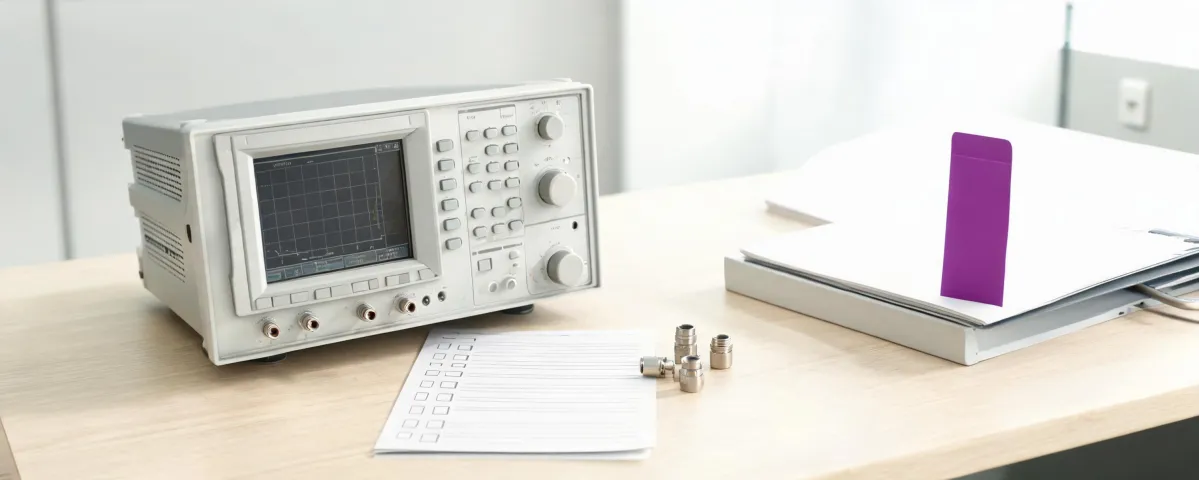
Procurement notes spread beside an unbranded analyzer on a light desk

Four handoffs, each with a different owner

1. Capture

The buyer states the measurement task. For a communications bench that may be a 2 GHz spur check. For a millimeter bench it may be a 50 GHz, 67 GHz, or 70 GHz component sweep. The desk records start frequency, stop frequency, RBW, impedance, and the connector series. Unknown cells stay marked unknown.

2. Match the question, not a logo

Suppliers are asked to name the exact model they will quote. A family name is a prompt. It does not prove displayed average noise level, phase noise, or preamp gain. Measurement accuracy is taken from the document tied to that model, at the attenuator setting the buyer will use.

3. Normalize the commercial row

Currency, Incoterm, freight, duties, licenses, and accessories are lined up. An optional target budget needs a currency and a per-unit or whole-order basis. A preference for high-end, mid-range, budget, or undecided factories is the buyer stance. It is not a grade the desk has audited.

4. Leave acceptance with the buyer

The desk does not sign the deviation, does not torque the connector, and does not issue calibration traceability. Incoming inspection, a known source if the lab has one, and the certificate date remain the buyer quality plan. If a page on this site and a datasheet disagree, the datasheet for the proposed serial controls the decision.

Limits the desk repeats: no street counter, no published phone line, no claim that a plant was visited, and no percent cut versus a market price. FREE sourcing support and sourcing support up to 3% follow the eligibility line in the footer. They are not a fixed reduction.

Questions the desk sends back when the brief is thin

Is the stop frequency a hard specification or a rounded title?
A 26 GHz search often means 26.5 GHz on the datasheet. A 70 GHz search may be a 67 GHz 1.85 mm frame or a 1.0 mm frame. The desk asks which mechanical port the bench will mate.
Which accessory scope is in the money?
Cables, adapters, a cal kit, and a software license change both the technical result and the payable total. Return loss of an adapter above 40 GHz is a reason to keep it on its own line.
What evidence is mandatory before the purchase order?
Some buyers need the calibration certificate in the same shipment. Others accept a later PDF if the serial matches. The desk does not choose. It writes the rule the buyer stated.
Who accepts a deviation?
If a supplier offers a swept analyzer when the lab asked for a real-time view, or a refurbished frame when the brief said new, the named approver has to answer. The desk records the split. It does not close it.

See how a multi-line sheet is built on the BOM workflow, or start from the inquiry cards when you already have a stop frequency in mind. The procurement note uses the same columns in a longer checklist.

Ask factories against the written scope

Send the product family, the application, the interfaces, the quantity, the destination, and the timing. Missing cells come back as questions rather than as guessed specifications.

Request Factory Quotes