Line-by-line sheet
50 ghz spectrum analyzer purchases break when the cable is missing from the BOM
- Analyzer frame and options
- Test port and connector saver
- Cable and any adapter
- Calibration kit or ecal module
- Software license and support term
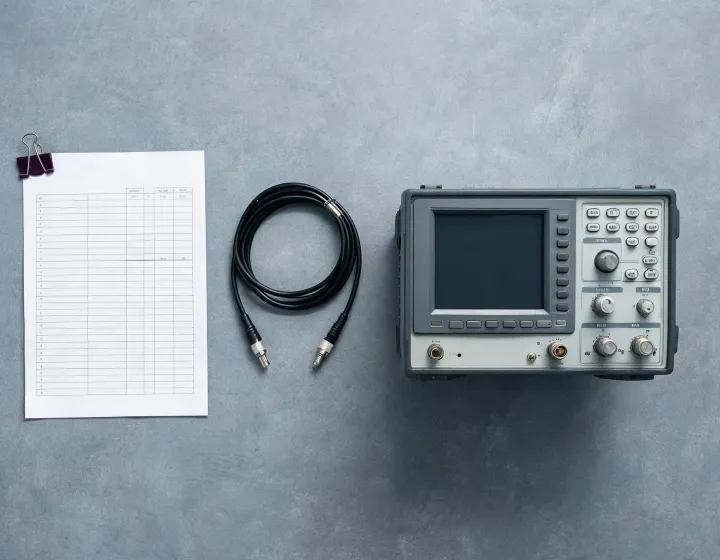
LinkScope Sourcing 54 uses this workflow so a 50 ghz spectrum analyzer request is a set of lines, not one lump price. A 2.4 mm port is a frequent mechanical choice near 50 GHz. A 2.92 mm cable that was fine at 40 GHz can be the wrong mate, and a photo will not show the difference.
What each BOM line must carry before quotes are compared
- Frame
- Model, frequency range with a real start and a 50 GHz stop if that is the need, RBW set you will use, and whether the preamp is installed. Measurement accuracy is copied from the model datasheet at a stated attenuator, for example plus or minus 0.6 dB to 3 GHz and a wider window above 26.5 GHz. Those numbers are prompts. They are not ratings this desk measured.
- Port hardware
- Connector series, a saver if the bench mates cables daily, and the connector mating cycle figure if the maker publishes one. Impedance stays 50 ohm unless you write a different plant. VSWR of the port at 50 GHz belongs on the drawing, not in a slogan.
- Cable and adapter
- Length, connector pair, insertion loss at 10 GHz, 26.5 GHz, and 50 GHz, and return loss at those same points. An adapter from 2.4 mm to 1.85 mm is its own line because it changes the uncertainty above 40 GHz.
- Calibration kit
- Mechanical kit or electronic module, the frequencies it covers, and who issues the kit certificate. Calibration traceability for the analyzer and for the kit are two certificates. One does not replace the other.
- License and exclusions
- Which measurements are software options, the term, and whether year-two renewal is excluded. Freight, duties, crate, and commissioning stay off the unit line until a supplier writes them in.
A second procurement scenario: a buyer building a five-line sheet for a 50 GHz amplifier check typed the analyzer, a 0.6 m cable, a 2.4 mm to 2.92 mm adapter, a cal kit, and a one-year license. Two factories returned totals. The desk asked each to repeat insertion loss of the cable at 50 GHz and to say whether the cal kit uncertainty table was included. One total had folded a short adapter into the analyzer price and had no loss figure. Once the lines were split, the buyer could see the adapter was unspecified. No percent saving was published, because the scopes were not yet the same purchase.
Maker-original accessories versus a compatible spare
| Question | Maker-original path | Compatible path |
|---|---|---|
| Why a buyer picks it | The cable, cal kit, or option code follows the uncertainty and the software policy the analyzer manual describes. Support conversations stay inside one maker when that policy matters. | A second source can shorten a wait for a 2.4 mm cable or a saver. The spare is usable when its own loss, return loss, and mating spec are written down. |
| What still has to be checked | The option code on the quote must match the serial. A manual that mentions a port does not prove the port is on the unit you will receive. | A compatible adapter can raise VSWR and insertion loss above 40 GHz. Ask for the supplier loss plot at 50 GHz. A thread that mates is not a flatness proof. |
| What this desk will not do | It will not call the original path authorized, and it will not say the maker will support a mixed rack. | It will not rank the compatible maker. Your preference for a high-end or budget source stays your preference. |
Open choices to close before you accept an alternate: the stop frequency if someone offers 40 GHz hardware against a 50 GHz line; the preamp state; the analysis bandwidth if you also need a real-time view; the certificate date; and the Incoterm. Receiver sensitivity without the RBW and the attenuation is not a substitute for those cells. Gain of the preamp, when quoted, should say the band, because a low-band gain figure can be larger than the gain at 50 GHz.
Keep the bench route for project constraints and the span cards for inquiry names. Channel width and MIMO belong on a radio brief, not on this analyzer sheet, unless the device under test is a radio and you say so in the requirements box.
Send the five lines as text
Type or paste the frame, port, cable, kit, and license into the requirements field, with quantity, destination, and timing. This page does not accept a file upload. Optional budget still needs currency and a per-unit or whole-order basis.
Share Your BOM