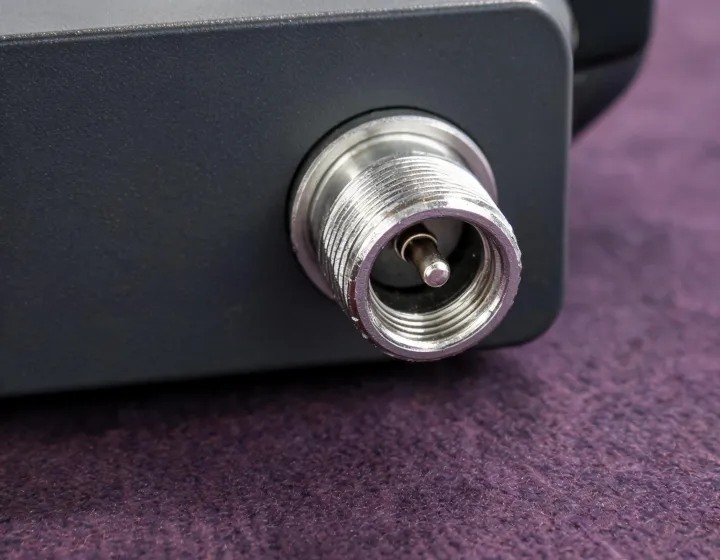
Port and span match
70 ghz spectrum analyzer quotes fail when the port and the span disagree
LinkScope Sourcing 54 coordinates factory quotations. It does not own the analyzer and it does not hold inventory. A 70 ghz spectrum analyzer request is comparable when every supplier answers the same cells: frequency range, connector series, resolution bandwidth, preamp state, and the documents that travel with the serial.
Many millimeter frames use a 1.85 mm port through about 67 GHz and a 1.0 mm port when the specified stop moves toward 110 GHz. A 70 GHz title can sit on either mechanical family. The adapter you already own may raise VSWR and insertion loss above 50 GHz even when the thread looks similar. Write the port you will mate, not the port you hope the photo shows.
Request Factory QuotesCells each supplier must price for a 70 GHz row
-
Exact configuration
Manufacturer, model, options, and firmware family as the supplier will ship them. A 70 GHz stop with the microwave preamp installed is a different configuration from the same frame with the preamp omitted. Receiver sensitivity and the damage level both move.
-
Level and noise basis
Ask which RBW, attenuation, and preamp state support the displayed average noise level. A buyer might request the figure at 1 GHz, at 26.5 GHz, and at 67 GHz, each in a 10 Hz or 100 Hz RBW. Phase noise, if the lab cares, should name the offset, such as 10 kHz or 100 kHz from a stated carrier.
-
Commercial lines that are easy to drop
Quantity, currency, per-unit or whole-order basis, Incoterm, named place, freight, duties, and the requested timing. A connector saver, a torque wrench, and a calibration certificate are separate lines. If they are absent, mark them excluded before anyone compares totals.
-
Evidence bound to the serial
Current datasheet, port drawing, test conditions, and calibration traceability. ISO 9001, when a buyer asks for the supplier quality system, is a certificate for that supplier, not a statement that this website audited the plant. FCC or safety files are requested when the destination team says they apply.
Do not treat a matching gigahertz number as interoperability with your waveguide transition or your existing cal kit. Host software, license keys, and the LAN or USB control path need their own yes or no. This page does not publish a percent saving. Compare factory quotations on the same configuration, quantity, currency, destination, and delivered scope.
Evidence the quotation must attach, not imply
What proves the 70 GHz amplitude window?
Request the table that states measurement accuracy across frequency, with the attenuator and the temperature. A single plus or minus 1.5 dB line that ends at 50 GHz does not cover a 70 GHz stop. Warm-up time belongs in the same note.
Who issues the calibration and when does the interval start?
A 12-month interval that starts at the factory test date may be partly consumed on arrival. Ask whether the certificate lists the 1.0 mm or 1.85 mm port that is on the unit, and whether a later recertification is included in the price.
Are cables and adapters inside the price?
A 1.0 mm cable has its own insertion loss and return loss. An original maker cable follows the uncertainty the analyzer manual assumes. A compatible cable can be the practical spare and can still fail the return-loss mask above 60 GHz. State which side you want quoted.
Which costs sit outside the unit figure?
Export packing, a wooden crate for a rack unit chassis, software renewal after year one, and on-site commissioning are common exclusions. Write them as included or excluded. Silence is not inclusion.
The span cards hold the inquiry names. The BOM workflow is the place to split analyzer, cable, adapter, and cal kit into lines before this RFQ goes out.
Hand the 70 GHz sheet to the desk
Include frequency range, port series, RBW, preamp, quantity, US destination, and requested timing. An optional budget states currency and whether it is per unit or for the whole order. Supplier preference, high-end, mid-range, budget, or undecided, stays a buyer choice.